

Beyond Hierarchy: Why Collaborative Leadership Is the Future of Mission-Driven Organizations
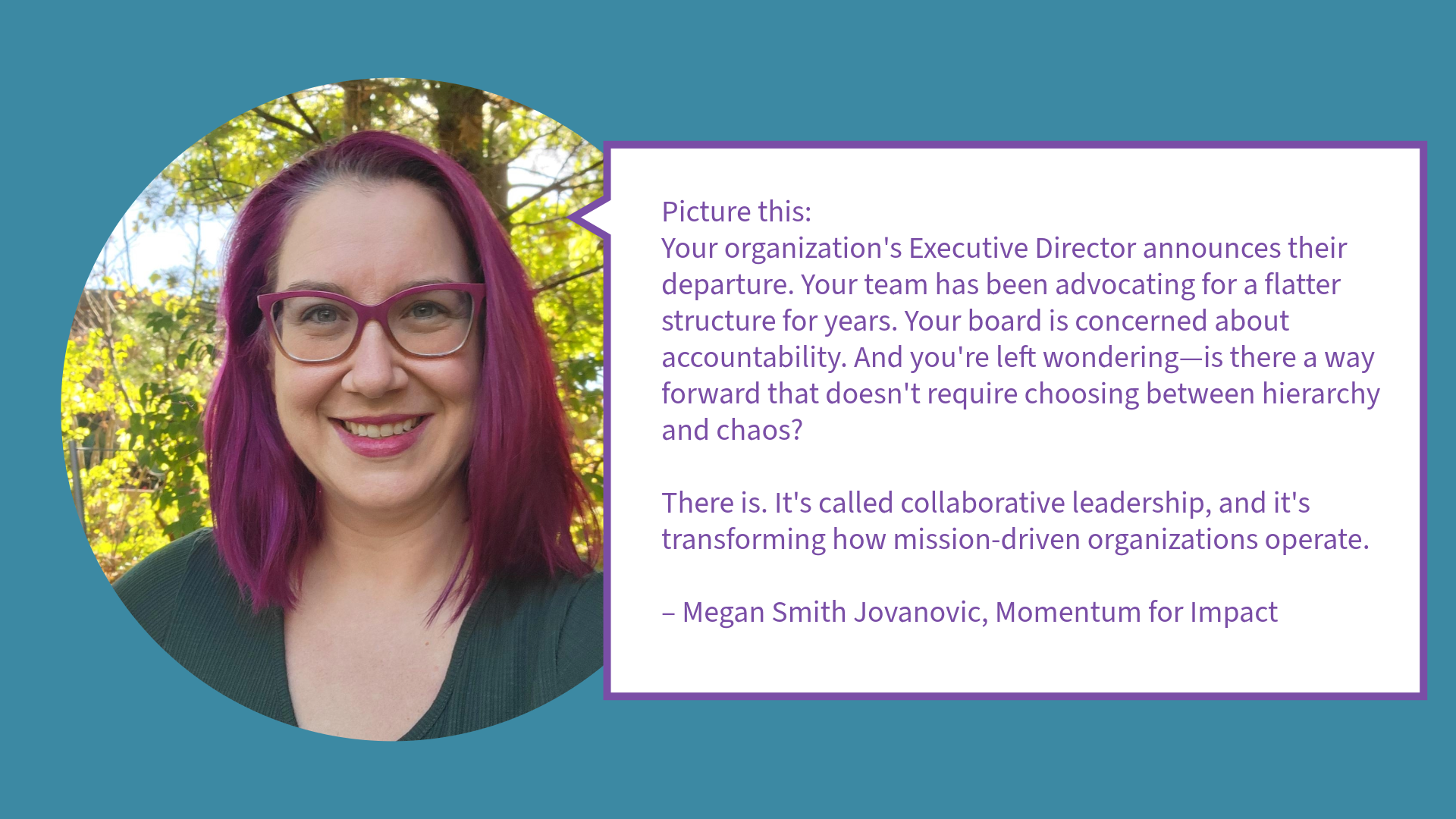
The Problem with Traditional Hierarchies (and Pure Consensus)
Traditional hierarchical leadership—with its clear chain of command and top-down decision-making—worked well in an era when efficiency and control were paramount. But in today's nonprofit landscape, where innovation, agility, and staff engagement are critical to mission success, rigid hierarchies often create more problems than they solve.
Common challenges with traditional hierarchy:
Decisions bottleneck at the top, slowing response time
Frontline expertise gets ignored
Staff disengagement and turnover increase
Innovation stalls because ideas must travel up the ladder
Organizational silos develop, hindering collaboration
On the flip side, some organizations swing to pure consensus models—where every decision requires everyone's agreement. While this sounds democratic and inclusive, it often creates its own dysfunction: endless meetings, decision paralysis, expertise disregarded, and team members who quietly disengage rather than blocking consensus.
Enter Collaborative Leadership: The Middle Path
Collaborative leadership is neither hierarchical nor consensus-based. Instead, it's a flexible framework where power and authority are distributed strategically based on expertise, context, and the nature of each decision.
"Collaborative leadership distributes power without eliminating structure. It values inclusion without sacrificing efficiency. It builds accountability without creating hierarchy."
At its core, collaborative leadership recognizes a simple truth: not every decision needs the same process. Strategic decisions about organizational direction benefit from broad input and consensus. Operational decisions within someone's clear domain can be made quickly by the person with expertise. The key is matching the decision to the right process.
The Framework: How Collaborative Leadership Actually Works
Through our work with mission-driven organizations like West Michigan Environmental Action Council, we've developed a practical framework with three core elements:
1. Tiered Decision-Making
Not all decisions need the same process. Some can be made autonomously, some need input, some require consensus, and some belong to the board. A tiered framework eliminates the guesswork about when to consult, when to decide, and when to build consensus.
2. Distributed Accountability
The biggest trap in collaborative structures? "Everyone's responsible so no one's responsible." We help organizations distribute accountability by deliverable (not by person), ensuring someone is clearly Accountable for each outcome—based on expertise, not hierarchy.
3. Conflict Navigation Tools
In collaborative structures, conflict isn't a bug—it's a feature. We teach teams practical tools to address accountability gaps, test assumptions, pause heated conversations, and surface concerns before they become blockers. These aren't touchy-feely exercises—they're frameworks that help teams address issues directly, kindly, and effectively.
What Makes Collaborative Leadership Work (And When It Fails)
Collaborative leadership isn't a magic solution. Like any organizational model, it requires specific conditions to succeed:
Success Conditions:
Small team size (3-5 people per working group)
High interaction frequency (weekly minimum)
Transparent work tracking (visible dashboards)
Strong peer accountability culture
Clear escalation pathways
Defined reporting structures to keep boards informed
Without these conditions, collaborative leadership can devolve into the worst of both worlds: unclear accountability AND slow decision-making.
That's why implementation matters as much as philosophy. You can't just declare "we're collaborative now" and hope for the best. You need frameworks, tools, practice, and ongoing iteration.
Real Results: What Happens When You Get It Right
When collaborative leadership is implemented well, organizations see faster operational decisions, better strategic choices, higher staff retention, increased innovation, resilient culture, and clearer accountability. Domain experts can move quickly without waiting for approval, while diverse perspectives surface early on major decisions.
Perhaps most importantly: when leadership is distributed, the organization doesn't collapse when one person leaves.
Is Your Organization Ready for Collaborative Leadership?
Consider whether your organization is experiencing any of these signs:
Leadership transition creating uncertainty about structure
Staff advocating for more voice in decision-making
Board concerned about accountability in flatter structures
Decisions taking too long or getting stuck
Talented staff leaving because they don't feel empowered
Lack of clarity about who's responsible for what
Conflict avoided rather than addressed constructively
If any of these resonate, collaborative leadership might be the path forward.
Building Collaborative Leadership Takes Intentional Practice
Here's what most organizations get wrong: they think collaborative leadership is about removing structure. It's not. It's about redistributing structure intentionally.
You can't just eliminate your ED position and hope people figure it out. You need:
Clear frameworks for how decisions get made
Explicit role definitions so everyone knows who's accountable for what
Conflict navigation skills to address issues directly and kindly
Practice sessions to build confidence using new tools
Ongoing support as you iterate and refine your approach
This is where facilitated training makes all the difference. Teams need time and space to learn these frameworks, practice the tools, surface concerns, and build shared agreements about how they'll work together.
What a Collaborative Leadership Training Looks Like
At Momentum for Impact, we design collaborative leadership trainings that are:
Practical, not theoretical. We focus on tools you can use immediately, not abstract concepts.
Customized to your context. We work with your actual org chart, your real decisions, your specific tensions.
Practice-heavy. We role-play conflict scenarios, facilitate real decisions, and build muscle memory for new approaches.
Iterative. Change doesn't happen in one workshop—we build in checkpoints and refinement sessions.
Board-aligned. We help you address governance concerns about accountability and oversight.
A typical engagement involves 4-5 training sessions spread over several weeks, allowing time for teams to practice between sessions, surface challenges, and refine their approach. We provide tools, frameworks, quick reference guides, and ongoing support as teams implement what they've learned.
The Bottom Line
Collaborative leadership isn't about eliminating structure—it's about redesigning structure to match the realities of modern mission-driven work. It's about distributing power without losing accountability. It's about moving faster on operational decisions while slowing down for strategic ones. It's about building organizations that are resilient, innovative, and deeply aligned with their values.
But it doesn't happen by accident. It requires intentional design, practical tools, skilled facilitation, and ongoing practice.
If your organization is ready to move beyond traditional hierarchy—or stuck in consensus paralysis—collaborative leadership might be exactly what you need.
Ready to explore collaborative leadership for your organization?
Momentum for Impact designs and facilitates collaborative leadership trainings customized to your organization's unique context, challenges, and goals. We work with mission-driven nonprofits, social enterprises, and advocacy organizations ready to build more distributed, accountable, and resilient leadership structures.